Showing posts with label Provo Temple. Show all posts

Monday, February 8, 2016

Why were the first Ogden/Provo temples designed the way they were?

                                   The original Ogden Temple, 1972-2011.


                               The Provo Temple in 2014.

 THE original Ogden Temple -- and the current Provo Temple -- was/is like something out of "Star Trek." Their "modernish" architecture was simply strange ...
  How did such "birthday cake" looking edifices, or a "sci-fi" kind of design like that ever come to be for the most sacred of structures in The Church of Jesus Christ of Latter-day Saints?


                            Original Ogden Temple/Modern Tabernacle.

Short answer: The Ogden and Provo temples had strict budget restraints and were not supposed to be fancy, have multiple towers or any excesses. Ogden was also the first temple ever built specifically for the endowment film and to have sessions every 20 minutes.

 Long answer of design/development of the Ogden Temple, the first of the two temples to be constructed and completed:


                                             Fred A. Baker.

 Fred A. Baker, was assistant chairman of the Church Building Committee, from 1965-1972 and became the Church Building Committee Chairman from 1972-1991.
As the only surviving member of the Church's original building committee, I sat down for 2 1/2 hours with Brother Baker and got the story on the Ogden Temple from the only one left on Earth who was there and knows the whole story of it. (Also, the Church History Department had conducted some earlier interviews with Brother Baker on the Church's building committee during his tenure.)
   
From Brother Baker:


                                               President McKay


"President McKay has decided that he wants to do this. But he's ... how shall I put it … he is so terrified that the people will think he's a spendthrift. After the budget thing that we've been through and everything else, now, because that seems solved, suddenly we have the money for two new temples.
 “President McKay said, ‘We’ve never announced two temples. The people will think I’m insane. People will think I’m going to spend the Church right out of money. How can we do that?’ I mean, he was really concerned about this whole thing.


                                             Emil Fetzer.

  “So he is absolutely determined that these will be the most austere buildings ever built. And while we're present; the six of us; he gives Emil (Fetzer, the Church Architect) absolute, very clear instructions ... boy, no kidding about the instructions. There will be NO solemn assembly room. There's one in Salt Lake, one in Logan, one in Manti  ...  if they need a solemn assembly room, they can travel. There will be NO multiple spires. That is not necessary. A single spire is fine. No multiple spires. There will NOT be any excess footage. He's seen the typical temple where there's footage by the ton, because you don't build a temple on an austere basis  ... there will be NO cubage, because he's been up there and looked at that forty-foot ceiling and said, ‘Oh, I'm having to heat and air condition that’, you know?
  And so, I'm not kidding, I'm talking about austerity! "You must use [one] plan for the buildings. You can change the exterior panels to be slightly different if you want to make them look different, but the plan … I'm not paying for two architectural plans. ‘One plan.’”


  The Building Committee was also told that there was to be no Angel Moroni on the top of the two temples.
Notwithstanding, the Committee members still made sure the towers of both the Ogden and Provo temples would be strong enough to support such a statue, being unconvinced they still would not be added some day.

  Brother Fetzer was told by the First Presidency that even though the temples must accommodate large numbers of people, the costs must be kept at appropriately reasonable amounts. The temples were not to be as large or expensive as those in Oakland and Los Angeles, but they were to be full-size temples and not to be confused with the smaller temples of limited capacity, such as those built in New Zealand, Switzerland, and England.
The idea was that the Ogden and Provo temples would prolong the time before the Logan and Manti temples had to be refurbished also.
(It was estimated that to build a Los Angles style temple in 1972 would have cost about $12 million, or about three times as much as the Ogden Temple did.)

   “In describing how the ideas for the temples came about, Brother Fetzer once recalled: “I think this is the only building that I have designed in words before I started to put marks on paper.”

  Brother Baker’s recollections of the Ogden Temple beginnings continued: “And so Emil has to go back and get his nice little temple staff carved out and swear them to secrecy to keep all this going. We're just thunderstruck. Suddenly we've got two new temples we've never thought we'd even think about...that sort of thing. So Emil gets his little staff together and starts working on sketches. We're probably three months in by that time, and Emil and I are scheduled to go to London. But Emil has been in Los Angeles all week refurbishing the Los Angeles temple, and I've been in Salt Lake all week taking care of the building program, and we're going to meet Friday night at the PanAm building in New York and jump on PanAm.”

  Next, Brother Baker is informed the First Presidency has had BYU produce a new temple (endowment) film. It has been approved it (with some minor changes), and the Presidency has decided there is now authorization to use the film in North America.
  (Previously, there had been an endowment film in European Temples, because of the language differences, but never domestically.)
  “Wow! That's a dramatic change,” Brother Baker recalled thinking.
  This was a significant change, because it meant that the Ogden and Provo temples would not need to be designed with a “move room-to-room” (“Companies”) basis for the endowment now. An endowment film meant one room, plus a Celestial Room would be sufficient.


  Brother Fetzer’s architectural plans for the twin temples were then almost three months along. The First Presidency wanted a revised draft plan for the two temples by the following week. And, the plane trip to London was in the way.
  Brother Baker recalled: “There went Emil’s sketches, right out the window. All that work and everything . . .  I couldn’t wait to tell Emil because this meant multiple ordinance rooms would be possible. This revolutionized temple work. And I thought, ‘No, if I call him, it’ll wreck his whole day. He’ll never get the Los Angeles Temple’s colors. I’ll just wait until we meet.’”


  Here’s how Brother Baker recalls that historic plane flight to London:
  “So, I fly Friday morning to New York, and he flies Friday morning to New York, and we get there at 8:00 o'clock at night and get on PanAm, and we're on our way to London. As we get on the airplane, the stewardesses say, ‘We're late tonight, as you know, so instead of  the food being delivered cold, we had it all delivered all warm, so it's all ready for you, the minute we take off you're going to eat.’
  “And I say, ‘Well, I don't want to tell Emil. I don't want to spoil his steak. So, I guess I'll wait until we eat.’”
  “We have a nice dinner, and clear everything away, and then I can say to him now, ‘Emil, I have some good news and some bad news. Which would you like to know about?."
  “And he said, ‘Let's get the bad news out of the way.’"
  “I said, ‘Well, your three months of sketches, you can throw them in the garbage can, because it's all changed.’
  “He said, ‘What in the world do you mean?’"
  “So I said, ‘Well, first of all, we don't need companies any more. At all.’”
  "’You're kidding!" he said. ‘We've always had companies!’"
  “I said, ‘Well, you don't need them anymore. The computer is now taking over the company.’"
  "’Oh! That's great!’"
  “And then I said, ‘Next we have a new temple film which is authorized for use in the United States, as well as overseas.’"
  “At first that confuses him a little bit, and he says, ‘Now wait a minute! What do we need a film for?"’
  “And I said, ‘Well, you need it because you're going to have smaller temples everywhere. You're not going to have casts that can do that. It's too difficult: too challenging.’"
  "’Oh yeah’", he says, "’I can see that. That's going to...’”


  “Well, anyway. So I said, ‘"Think of the possibilities now. Here's a Celestial room, and now you can put several ordinance rooms around it, on a schedule, so that they operate with each other, not against each other. So you have a central Celestial room, you have several ordinance rooms, you have a veil space, and what we have to do now is get that organized so that it makes sense and works together and not against each other.’"
  “I don't know, when you went to school, did you have to do simultaneous equations? Those equations where you had to solve two things at the same time, and when you got the solution, both answers were right? That's what we were trying to do that night. Emil got a tracing paper out and we're working on these little tiny, silly tray tables; and the nice girl comes up and says, "’What in the world are you doing?’"
  “We said, "’We're trying to work on a plan.’"
  “She said, "Well, look ..."  Back in the good ole' days ... plane in those days was a ... across from the galley was a regular restaurant table. You know, the table with two benches, and the girls used that to get the meals ready and everything. She said,’ We're not using that, why don't you come back and spread your stuff out on that nice (table) ...’
  “So, geez, we went back and spread our stuff out and we started working...you see you had to know how many rooms, how many seats in a room. We knew the film length … We knew approximately how long it takes to get a number of people through the veil. And so you have all this information, and now you need to decide, ‘Let's see, now...how many rooms, and how will it fit together, and the clock's running and we worked and worked and worked and worked, and, of course, neither one of us are mathematicians; we're idiots. It was the biggest mess you've ever seen in your whole life. We had papers and formulas. It was just comical.’
  “Finally, we get down to a thing where we try five rooms ... that won't work. Four rooms ... doesn't come out. You've got conflict in the veil space every time, and then in the Celestial room every time. And we just fuss and fuss, and finally we got six rooms with eighty people in each room, and we start going around, starting a session every twenty minutes to see how it works out.
  “Surprisingly enough, it works out, except in the veil space. And we keep working, and keep trying to figure out, ‘How is that working? It works in the rooms, why doesn't it work in the veil space?’
  “And them Emil comes up with the idea. We were going, in rooms...one, two, three, four, five, six...and if you went one, six, and then in the middle, and then across, nobody ever saw each other in the veil space. It was just vacant when you went in there.
  “It all worked! And by the time we got that figured out, the captain came on and said, ‘In twenty minutes, folks, wake up; we're landing in London in twenty minutes .’ We worked all night long on that one little thing.
  Brother Fetzer’s design was influenced by a garden he had seen in Copenhagen, Denmark.

  Brother Baker recalled: “It was called the Danish ellipse. An ellipse is a circular form but not a circle. It has bent corners. During that night on the plane, we weren’t paying any attention to the design of the temple. We were trying to work out the mechanics. But when the mechanics worked the way Emil placed them, that turned out to be the ellipse. And that’s President McKay again, ‘I don’t want any excess space.’ And there wasn’t any. It was six rooms, a celestial room . . . I mean, it fit. And when he finally put the design together, we didn’t want the rectangle, so Emil rounded everything. It was called the Danish ellipse.

    “ … We took it back to the Presidency and they said, ‘Eureka! Let's go with that plan.’ And so suddenly we had a domestic temple that had the potential to just totally explode vicarious work for the dead,” Brother Baker recalled.
  “Isn’t that amazing? And it all came because Presidency made those decisions early on about switching to film. That changed everything. Everything just fell into place—absolutely unbelievable.”
 Brother Fetzer, the final “church architect" (and who served from 1965-1986), designed the Ogden/Provo Temples. However, Keith W. Wilcox, another Utah architect, is often erroneously stated as their designer. Brother Wilcox, as president of the Weber Heights Stake, was the today's equivalent of the "agent stake president" during the Ogden Temple's construction. He also drew the sketch than became the inspiration for the Washington, D.C. Temple and was the Ogden Temple’s third president.  Hence the confusion.
Another problem to solve for the Ogden Temple was where to locate it.
Jim Seely has provided yet another insight into why the Ogden and Provo temples were designed the way they were. He said that Keith W. Wilcox told him that Emil Fetzer based some of the design for the exterior of those temples on Exodus 13:21, which states" "The Lord was going before them in a pillar of cloud by day to lead them on the way and in a pillar of light by night ..."
Thus, the white facade of the Temples was the white cloud and the golden spire was lighted at night to represent a pillar of fire.

Brother Baker said sites in North Ogden, northwest Ogden, the mouths of the canyons, near Weber State College, and basically much of the east bench were all investigated as possible temple locations for an Ogden Temple.
Many sites were unsuitable, because they were not available for purchase.
  In the end, the three finalists were these sites:

                                       The still steepled-Ogden Tabernacle in 2011.

1.    Tabernacle Square.


                    Former McKay Dee Hospital site in 2014.

 2. The property where the future McKay-Dee hospital at 39th and Harrison Boulevard would stand, across from Weber State University.


                                      The top of 9th Street in 2014.

 3. The top of 9th Street (east of Ben Lomond High).


Regarding the third choice, Charles C. "Chick" Hislop, former Weber State University cross county/track coach, said that was his parent’s property, Curtis and Jennie Hislop. He said his father always relished that his land was in the top three finalists.
  With the railroad industry, previously Ogden's "bread and butter" business shrinking, some downtown business leaders also heavily lobbied the First Presidency to have the temple built downtown, instead of on the hillside.
  That effort was really not required as LDS Church leaders chose historic Tabernacle Square on their own as the new temple site. Physical address of the new temple was on the 10 acres, southeast corner, 350 22nd Street.
  “The First Presidency announced plans to construct temples in Provo and Ogden, Utah, in meetings with stake presidencies from the two areas,” the Improvement Era magazine of October 1967 stated as having been announced on July 14 that year.
  The Ogden Temple’s location was officially announced on August 24, 1967 for downtown Ogden on Tabernacle 
Square.


 Tabernacle Square in Ogden was chosen by President Brigham Young, when he laid out the city in the fall of 1850. So, in essence, President Young himself indirectly chose the general site for the Ogden Temple too.
  In the fall of 1967, some excited Church members emptied piggy banks, postponed vacations and cutback on Christmas gifts that year, all to donate to the new temple’s construction.
  “Church members responded to the opportunity to contribute toward the building of the temples with great enthusiasm,” according to the January 1972 Ensign Magazine. “One bishop discussed the quota for his ward in priesthood meeting, and by the time Sunday School was over, the total quota had been contributed in cash. One family had saved for a special vacation, but they voted in their family home evening to donate the total amount to the temple fund and save again for their postponed vacation.”

  The February 1971 New Era Magazine chronicled the account of a ward in Harrisville, Utah that had been assessed $3,461 for the construction of the Ogden Temple. The bishop approached the youth of the ward, hoping to get them involved and to make up an anticipated shortfall in the fund-raising.
The girls scraped and painted old barns, tended children, bottled fruit and did ironing.
 The boys did everything  from washing cars to laying sewer pipe and the money was all raised.

  President Albert L. Bott of the Mt. Ogden Stake was the chairman of the temple’s finance committee.
  (Before April of 1982, many construction costs in the church came from stake and ward building assessments. From then, the church’s general fund paid for church building costs.)
 The drawings for the Ogden Temple were approved in early 1968. The Ogden temple site was finally dedicated on September 8, 1969 by President Joseph Fielding Smith and Elder Alvin R. Dyer. The groundbreaking was held the same day as President McKay’s 96th birthday), with Elder Hugh B. Brown turning over the first shovel of dirt.
  "This temple is being built because the Lord wants it built," President N. Eldon Tanner, stated in the Sept. 12, 1970 LDS Church News.
 President Tanner had laid the cornerstone on Sept. 7, 1970. Some 6,000 people attended that ceremony.
  According to the Sept. 12, 1970 Church News, The cornerstone of the Ogden Temple's time capsule is a copper sealed box that is 31 X 24 X 8 inches in size. It includes photographs of LDS General Authorities at the time and also of area stake presidents. In addition, it includes a picture of the U.S. President, Richard M. Nixon, as well as copies of current church magazines, Standard Works, church brochures and other historical materials.


However, there was one big casualty to the original Ogden Temple – the old Pioneer Tabernacle had to go. To make room for a temple, this historic structure was torn down in late summer of 1971.
  The 116-year-old building, on the Southeast corner of the Tabernacle Block, dated back to 1855 and had been remodeled several times, extensively in 1896 and again in 1966.
 That pioneer building was it was so close to the sidewalk on the south side of tabernacle Square, that if someone was asked to speak extemporaneously and they happen to be sitting in the rear of that Tabernacle, it was far quicker for them to exit the building, travel on the sidewalk and walk in the southeast door instead to the podium. (Thus, it sometimes seemed such such speakers were fleeing the scene.)

  Brother Baker recalled that the Pioneer Tabernacle was a structural disaster and had to go.
  “It was the worst example of a building he said. It had no class.”
 This building, being used as a genealogical library at the time, was located just southeast of the parameter of today's Ogden Temple and had to go.
  “On Aug. 31, 1971, a mechanical monster took a giant bite out of one of Ogden’s pioneer edifices – the historical LDS Tabernacle,” an Ogden Standard-Examiner story of June 29, 1975 recalled.
  “It was a power shovel that, within a few hours, had leveled the 116-year-old building which had served as a major center of religious activity in Weber County since its dedication in October 1869,” the story stated.
  It had  a “visual conflict” with the proposed new Ogden Temple, besides its poor condition.
  Additionally, an old Third Ward Chapel, also still located on Tabernacle Square was torn down too.
  According to the LDS Church News of Feb. 3, 1968, completion of the temple was originally planned sometime in 1970. However, that was not to be.
  Underground water problems, in particular, delayed construction about a year. (That's also what caused delays in the completion of the second Ogden Temple too.)


  Despite the many similarities between the Ogden Provo temples, they were certainly not identical.
According to an article by Doyle L. Green, “Two Temples to be Dedicated,” in the January 1972 Ensign Magazine:
“Even though at first glance the exteriors of the two new temples look the same, a closer inspection will show that they are quite different. The arches and grillwork for the doors and windows on the main floors have different configurations. The cast stone on the Provo Temple has a bas relief floral design whereas the Ogden Temple stone has a fluted appearance. An interesting feature of the Ogden Temple is the decorative metal grillwork covering the windows between the cast stone on the third floor. The floral or fountain motif is repeated in the tower of the Provo Temple, and the fluted column effect is beautifully featured in the Ogden tower, giving the towers, which rise –to a height of 180 feet above ground level, quite a different appearance.”

DEDICATION OF THE FIRST OGDEN TEMPLE:

  The Ogden dedication celebration actually began on Dec. 14, 1971, with a special dinner at the Weber Heights Stake Center, for area leaders, many General Authorities, and the Presidencies of the Ogden, Provo and Logan temples, and their wives.

                                           Keith W. Wilcox.

“There was a very joyous air being experienced everywhere,” the journal of Keith W. Wilcox recorded of the dinner. ”People sensed that this was a very rare moment and appreciated being a part of it. There seemed to be a ‘tingle’ in the air.”
Brother Wilcox was also the Weber Heights Stake President.  His appointment over that temple project several years earlier had marked the first time a non-General Authority had held such a position on a temple-building project.
(Today, President Wilcox’s title would be “agent stake president” over the project – and President Wilcox would himself later be called as a General Authority, a member of the Seventy, from 1984-1989.)
  “At 7:00 p.m., I arose to make all welcome. I indicated that this particular hour was truly our ‘finest hour’ not only as stakes but an entire community.”
“After discussing the effect of the Temple on the community, I stated, ‘The Temple coming to our community has raised the general spiritual level to a great height.’ At this point the choir sang the ‘Hallelujah Chorus.’ We then distributed copies of the January 1972 Ensign which had been printed exclusively on new temples featuring the Ogden and Provo temples.”
The following day, Dec. 15, were tours of the Ogden Temple by leaders, VIPs and the press.
  Brother Wilcox said tour were made in the Ogden temple by groups of 35.
  “Those in the tour were tremendously impressed with what they saw,” Brother Wilcox’s journal recorded. “Going through the Temple was a thrill hard to describe. Everyone felt the effect of the spaces, especially the Celestial Room, which was magnificent achievement. It was truly a memorable evening and it truly became our ‘finest hour.’ Many have said since, that they will remember this evening as long as they live. It was that kind of gathering.”
  By the end of the evening, 5,797 individuals had toured the temple.
    A public open house for the original Ogden Temple was then held daily from December 16-30, 1971 (except Sundays and Christmas Day).  It was estimated that more than 150,000 people attended the open house.
  The temple, which cost $4.29 million (or about $25 million in 2014 dollar values), was dedicated on January 18-20, 1972, by President Joseph Fielding Smith. There were two dedicatory sessions on each of the three days.
President Smith arrived in a limousine on Jan. 18, followed by three large buses carrying other General Authorities and their wives.
Keith W. Wilcox had arranged for the buses as the most convenient and practical way to transport so many leaders and their spouses, from Salt Lake to Ogden, for three straight days.


 As the first dedication services began, President Smith made the following introductory remarks:
“May I remind you that when we dedicate a house to the Lord what we really do is dedicate ourselves to the Lord’s service, with a covenant that we shall use the house in the way that He intends that it shall be used.”
President N. Eldon Tanner said the temple was a great blessing.  He suggested remembering the Temple in our prayers and that we can justify this temple by our attendance. He also pointed out that Jesus Christ did a great work for his with his atonement and that we can repay that debt by be willing to do vicarious work for others.

  President Erza Taft Benson stated in his sermon that this was the most important event that ever transpired in this great area of Ogden. He stressed that the Temple would bring us the treasures of Heaven.
In Elder Mark E. Peterson’s remarks, he said that the temple is the gateway to exaltation.
Patriarch Eldred G. Smith remarked that if young people understood the Celestial Law, they would walk from New York to Utah for a Temple marriage.
In between sessions, the General Authorities and their wives would board the buses again and went to a local restaurant for lunch.
  In the second dedication session, President Smith made reference to the Prophet David O. McKay and that the Lord had inspired him to proceed on the Ogden Temple.
  President Spencer W. Kimball admonished keeping the new Temple clean, sweet and pure. He pointed out that the Temple was like a new born baby – clean and pure from contamination.
  However, President Harold B. Lee had to finish one of the remaining one-third of one of the dedicatory prayers, when President Smith, then age 95, became too weak from standing so long.
  A portion of the dedicatory prayer stated: It has been our privilege, as guided by the whisperings of thy Spirit, to build unto thee this temple, which we now present unto thee as another of thy holy houses.
 Wherefore, according to the pattern thou hast given, and in harmony with the course pursued by thy servants who have been before, and acting in the authority of that priesthood which is after the order of thy Son, and in his holy name, we dedicate this, the Ogden Temple of the Church of Jesus Christ, to thee, the Lord.
  Still another portion of the dedicatory prayer was pertinent enough that it would be quoted in the “Teachings of the Presidents of the Church: Joseph Fielding Smith” priesthood/relief society manual for 2014:
 O, our Father, we long for the day when the Prince of Peace shall come, when the earth shall rest and righteousness be found again upon her face; and it is our prayer, spoken out of humble and contrite hearts, that we shall abide the day and be found worthy to live with him whom thou hast appointed to stand as King of kings and Lord of lords, to whom be glory and honor and power and might both now and forever.

  Talks given at each of the six sessions were all described as “very inspirational.”
The first Ogden Temple was dedicated inside the Celestial Room, in six different sessions, over three days, January 18-22, 1972. Closed circuit TV carried the dedication services to six other rooms in the Temple.
President Lee led the Hosannah Shout in all six of dedicatory sessions.


  The Ogden Temple area only included 24 stakes in 1972 and the temple district’s overall population at the time was 117,780 residents in Northern Utah and Southwestern Wyoming.

   Notwithstanding the 125-year wait, Ogden still had the church’s 14th temple (with the original version), which opened in 1972 and was also the first LDS temple built in the State of Utah – Since others were completed before Utah became a state and the first temple built in Utah territory in 79 years.
  However, the Ogden Temple came 95 years after the Logan Temple opened and 79 years after the Salt Lake Temple was completed -- an so Ogden area Saints had to wait a long, long time for a local temple.

  The new, 115,000-square-foot Ogden Temple had four floors, 283 rooms and soared 180 feet above the ground. Okland Construction was the contractor for the temple’s construction.


  The Temple boasted a modern design.
The ground floor was a square, providing a base for the two upper floors, the exterior stylobate of which is a modified oval in shape was how the Feb, 3, 1968 Church News described the Temple’s outside appearance.
The cast stone which covered the exterior of the Ogden Temple was formed in a fluted design. Between each panel of the stone there was metal grillwork, bronze in color and of intriguing design over windows covered with directional glass which appeared gold in color from the outside. The fiberglass tower was also gold in color.
  The Ogden Utah Temple was also, of course, constructed as a sister building to the Provo Utah Temple, which was built simultaneously and dedicated only a few weeks later than the Ogden Temple, on February 9, 1972.
  (Building the two identical temples together not only saved considerable money, but also shaved off about 18 months in construction time on the second temple, the Provo Temple.)

 Brother Baker said, "It was temple quality work," he said of the construction of the Ogden and Provo temples. "But we saved every penny we could. They were 'working' temples."
  Baker also admitted the building committee spent far more effort on the Ogden and Provo temple's interior, than on its outside appearance.


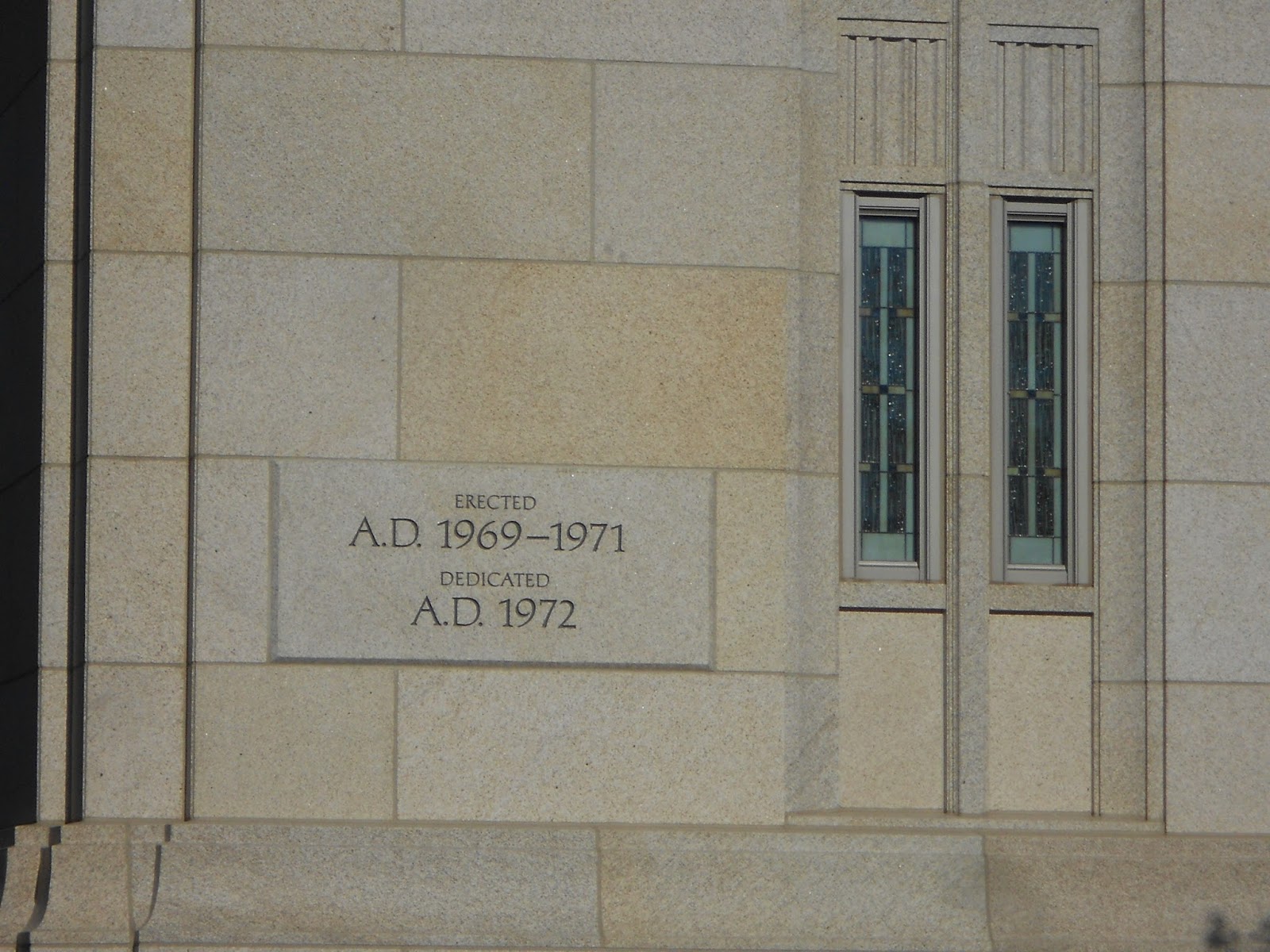
                Cornerstone of the first Ogden Temple, on the Northeast corner.


ON IMPRESSIVE STATISTICS AFTER THE OGDEN TEMPLE HAD OPENED:

 When the first week's report of temple work statistics from the Ogden Temple reached the desk of the First Presidency in late February 1972, Brother Baker said the Brethren scoffed at the report. They couldn't believe so much temple work could be performed in one temple in a single week.
  The Brethren were especially concerned that the "flagship temple," the Salt Lake Temple was being outdone by Ogden.
  Brother Baker said he had to take the report back and re-check all the figures.
  Then, when he delivered the first full month's report of temple work in late March of 1972, the Brethren were even more skeptical. He said they simply could not believe the Ogden Temple could do more temple work in a single month than in all four of the other temples in --Utah combined.
  

        President McKay and Church Building Committee. Fred Baker is in the center rear row.


Brother Baker recalled:
  “They (the Brethren) were not as happy as I thought they would be. Isn’t that funny? I was leaving the room with the secretary of the committee, and he said, ‘You look pretty glum, Fred.’ He knew exactly what I felt. I said, ‘Well, I expected a little excitement. I thought that was wonderful.’ He said, ‘You just don’t understand. These are the senior brethren of the Church. In their whole life they have never, ever thought that any temple would do more work than the Salt Lake Temple. That just isn’t possible. Salt Lake is the flagship temple for the whole Church and you go out and put this little temple in Ogden and they do more work than Salt Lake. Don’t you know that was wrong?’] I said, ‘I didn’t realize . . ‘And he said, ‘Now it wouldn’t have been quite as bad if it had been Provo because of BYU and the MTC. But Ogden? Ogden? You’ve got to be smarter than this.’
  “Then I thought, ‘Oh well. Now I can understand it.’  It wasn’t that they were unhappy, but they just weren’t thrilled. I thought, ‘This is worth the BYU band marching up and down the Ogden streets as far as I’m concerned. This is huge!’
          “Well, you can imagine what’s happened to vicarious work because of all the temples now built. The Salt Lake Temple is the flagship temple, not the flagship temple plan. So there you go. Isn’t that interesting?”

   Brother Baker had to re-verify those figures too, but they were correct as the Ogden Temple ushered in an explosion of temple work.

(LOGICALLY, the Provo Temple has the same design limitations and dating as did the original Ogden Temple. Therefore, it is very likely that temple too will one day undergo some significant remodeling.)

SOURCES:  Recorded/transcribed of interviews with Fred A. Baker on Sept. 8, 2014; other interviews with Fred A. Baker  by the Church History Department; Interview with Sister Viva Wilcox; Articles in the Church Archives; Ensign Magazine Archives;  Ogden Standard-Examiner archives.
(Fred A. Baker passed away in 2015.)

        Painting of the Ogden Temple by Keith Wilcox, as if it was right by the mountainside.


-NOTES: The author, Lynn Arave, co-wrote "Rededication: The History of the Ogden, Utah Temple" book with Janai Ott for the LDS Church in 2014. He can be contacted by email at: lynnarave@comcast.net
-This article and all of the NighUntoKolob blog are NOT an official website of The Church of Jesus Christ of Latter-day Saints. 

Thursday, December 17, 2015

The detailed story of the old and new Ogden Temples


                                     New Ogden Temple.

By Lynn Arave

NOTE: This article and all of the NighUntoKolob blog are NOT an official website of The Church of Jesus Christ of Latter-day Saints.

TODAY Ogden has a new stately-looking temple that replaced its original temple that didn't really look that much like a traditional temple (and was just 39 years old when it was torn down .... and dramatically remodeled).
The current Ogden Temple really stands out now, especially from the top of Washington Boulevard.


                          Original Ogden Temple, 1972-2011.

BUT WHY did it require more than a century before Ogden, Utah had its own Temple?

Short answer is because it was "Ogden."


The long answer AND the rest of the story of how Ogden's Temples came about follows:

(NOTE: Those involved in the Provo Temple will find this history interesting too, since it involves that sister edifice too.)

Ogden was settled in 1847 and was a town Brigham Young laid out, with deep roots in The Church of Jesus Christ of Latter-day Saints.
In fact, gold earned by the Mormon Battalion was used in 1847 to purchase the Ogden area from mountain man Miles Goodyear, who had already settled there.
The City of Ogden was also Utah's second-largest city for well over a century and often competed directly with Salt Lake City economically.
All one has to do is read the Salt Lake or Ogden newspapers of the late 19th and early 20th Century to get a glimpse of 
the competition and hoopla between the two cities. 
Ogden is just 36 miles north of Salt Lake City and today that equates to just barely over a half-hour drive on the freeway.
Yet, in the 19th Century and the early 20th Century, Ogden was a half-day's trip away or more from Salt Lake City, outside of railroad travel.


                            Ogden's railyard in its prime.

Ogden was "Junction city," that key railroad town that eventually attracted the liberals, unions and even non-Mormon mayors into its borders.


                                   Locomotive in Ogden on turntable during 1940s.

(Ironically, today Salt Lake City is much more "liberal" than Ogden.)
Even as recent as the 1960s, many LDS Church leaders in general  seemed to view Ogden as that liberal railroad town and thus a temple there was rarely a part of any serious discussion.
Surprisingly, even when David O. McKay, from Ogden Valley, east of Ogden City, became the 9th LDS Church President in 1951, that equation didn't rapidly change either.
Ogden, or even the greater Ogden area was apparently not suitable for its own temple decades ago.


                                       Logan Temple today.

The Logan Temple, about 44 miles north of Ogden, had opened in 1884 -- nine years before the Salt Lake Temple was completed.
Yet, access to Logan, except by railroad, was a difficult winter season endeavor, thanks to "Sardine Canyon," until 1960, when a new alignment of U.S. 89 through the canyon opened. A significant number of stakes in Weber County were in the Logan Temple District, until the first Ogden Temple came along in 1972.


                    The summit of "Sardine Canyon," looking northward.

 A common practice of many wards/stakes in the Ogden area in the 1960s was once a month to charter evening bus trips to the Logan Temple.
Ogden boasted plenty of its own active church members. In fact, during all of its history the Ogden area had 50 percent or more of its population as church members.
 Ogden area church members also significantly helped construct and finance the Salt Lake Temple, which was completed in 1893.
  By the 1920s, Ogden area church members were hungry for their own temple.
  “Ogden to get temple, Mormons are told,” was a headline in the Ogden Standard-Examiner newspaper on Dec. 13, 1920.
  Members were informed at the North Weber Stake quarterly conference by Church Patriarch Hyrum G. Smith that there would a temple for Ogden in the “near future.”
  Patriarch Smith spoke about the overcrowding in the Salt Lake Temple and stressed preparation for new construction of both a tabernacle and a temple.
 Then, some six months later in 1921, President Heber J. Grant visited Ogden, stating it was not the proper time to have a temple there.
The Deseret News on May 16, 1921 reported: “A temple site was inspected in this city early Sunday morning by Presidents Heber J. Grant and Anthony W. Ivins, together with local Church officials.”

Why President Grant's visit?
An Ogden man, Joseph Clark had offered a donation of many acres of land to the LDS Church, near 30th Street and Tyler Avenue, for a possible temple.


                               30th Street and Tyler sign today.


President Grant and several other leaders came to inspect the site.
This land, above and east of most Ogden bench housing of the era, already had a religious history of sorts.
According to the Ogden Standard-Examiner, in 1890, a Methodist University, nicknamed “Utah University,” was under construction there.
At least the first floor of that university's anchor building was finished by 1891, before the Methodist Church had a national financial crisis that halted all such projects.
So, the land was returned to Joseph Clark, who had sold it to the Methodists.
Clark apparently envisioned a future Ogden Temple, sitting on the hill above today's Ogden High School, where much of Ogden's populace could see it.
(Ogden High on Harrison Boulevard didn't open until 1937.)


                The former St. Benedict's Hospital today.                     Photo by Liz Arave Hafen

Later, this hillside section of land became the St. Benedict's Hospital, in 1946.


The Deseret News article reported this on President Grant's visit:
  “A movement has been on foot for a temple for this city for sometime past, owing to the great amount of activity of Church members in genealogical and temple work and the fact that only limited numbers can now be accommodated at the Salt Lake Temple. President Grant … announced that from $2 million to $3 million were now on application for other purposes and there was no telling when a temple could be built in Ogden.”

  President Grant then probably surprised Ogden area church members by proclaiming that if every member paid a full tithing, many more temples could be readily built, including one in Ogden.

 President Grant also went on to single out Ogden’s Lester Park (663 24th Street, where today’s Main Weber County Main Library is) as a superior Ogden temple site.
  Strangely, one of the planned church building projects that President Grant had referred to was the $300,000 Deseret Gymnasium in Ogden. It was then on the drawing board, and was finished in 1925.
What?
A gymnasium before a temple in Ogden? Yes, that's what happened.


  The preserved facade of the former Deseret Gymnasium today.           Photo by Liz Hafen.


Ogden area wards were also assessed amounts to pay for the Deseret Gym and some church leaders had even implied that after that building debt was paid, an Ogden  temple would be next to come.
 A Feb. 10, 1924 headline in the Standard-Examiner stated: “L.D.S. members looking forward to new temple and larger Tabernacle.”
  “That a temple may be built in Ogden within a few years is the fond hope of the large number of temple workers who are making regular visits to the Salt Lake and Logan temples,” the newspaper story stated. “A temple in Ogden would mean more temple work performed by local church people at less expense, as transportation expenses would then be eliminated.”


                           Ogden's Lester Park today.                               Photo by Liz Hafen.

  But history proves that President Grant was not really that keen on the Lester Park site for a temple in Ogden.
Indeed, the Standard-Examiner reported on May 7, 1924 that the Associated Clubs of Ogden had corresponded with President Grant about prospect of trading Tabernacle Square Park (site of today’s LDS Temple/Tabernacle) for Lester Park.
The said purpose of this trade was ultimately to provide “a suitable site for an Ogden temple.” This happened almost three years exactly after President Grant's initial visit to Ogden to ponder temple possibilities.
  However, that proposal was turned down too.
   As a sidelight, the LDS Church had actually given Ogden City the deed to most of Tabernacle Square in the early 1890s. But, the city decided it could not do anything with the property and so it was returned to the Church a few years afterward.
  The Standard-Examiner reported on Dec. 20, 1893: “The city gives it up. City Council gives back the Tabernacle Square to the church.”)
  Historically, there is also little doubt that the Great Depression, that hit in 1929, plus World War II in late 1941, were also at least indirect setbacks to potential Ogden temple prospects. 
Some 31 years after Ogden received its own Deseret Gymnasium, on February 12, 1956, the new Ogden Tabernacle was dedicated, -- the last such tabernacle the Church ever constructed.
But Ogden still remained temple-less.
 In the mid 1960s, Ogden continued to rank as Utah’s No. 2 city with a population of almost 69,000.
 The actual spark for an Ogden Temple actually came indirectly.
This effort involved the Church’s first-ever building committee -- with an Ogden resident who was one of its three founding members.
  In 1965, the First Presidency approved the creation of its first-ever building committee.


                                               Emil B. Fetzer.

Called to that landmark committee were: Mark B. Garff, construction company owner, as chairman; Fred A. Baker, a vice president of Ogden’s Commercial Security Bank, as vice chairman; and Emil B. Fetzer as church architect.


  This committee eventually established planning, structure and budgets to a growing Church that had previously “winged it" on its building projects.


                                       Fred A. Baker

  The committee first got world-wide chapel construction under consistent control and structure.
  Then, according to Fred A. Baker, who was assistant chairman of the Church Building Committee, from 1965-1972  (and who became the Church Building Committee Chairman from 1972-1991), President Tanner called for a meeting with the building committee in his office, and said, "We're very much concerned about the Manti temple and the Logan temple. They're overcrowded. The temple districts are too big for them, and we must do something to increase the through-put of the temples. Would you please go take a look at those temples and see what you can do to increase the size and make them so they can handle their districts better.”
  At that time, the Manti Temple had Provo and Utah County in its district and the Logan Temple included Ogden and Weber County in it borders --  and yet  they weren't built for that scope. They were designed to serve Manti and Logan.
Brother Baker continued to recollect in some taped interviews on the subject of the first Ogden Temple:

So we went to both temples, and of course, that's where you just tear your hair out,” Brother Baker recalled. “See, the temples are all grand-daddied as far as all the codes are concerned. As long as you don't touch them, the counties and the cities are kind enough to just leave you alone. You couldn't put another wire anywhere in the temple without moving something else: I mean, they've been there forever and they are chuck-full of every violation of every code ever imagined. So you're safe if you leave it alone, but the minute you say, ‘We need to change this,’ or, ‘We need to add this’, then the whole building must immediately be remodeled to meet the current codes.”
  Brother Baker continued: “Well, they didn't meet any of the fire codes. They didn't meet any of the illumination of getting out of the building. They didn't meet wiring. They didn't meet HVAC, they didn't meet engineering, I mean, you name it ... there was another violation right there.
  “So you're faced with literally ... literally tearing the building apart and adding something to it and then re-doing the whole building as a new building. That costs twice as much as building ... it's just not sensible, not practical. You don't get additional space that you need and all of that.”
  “Anyway, we're just scratching our heads,” Brother Baker recalled of 1967. “The only news you got is bad news.  There is no good news. Instead of saying, ‘We have good news and bad news, which would you like first?’, you say, ‘We have bad news and worse, which would you like first?’ It was just horrible.
  “And so we're driving back from Manti, and, you have to understand now, we've had this little bit of success with the budgeting and the new program and putting things together, and surprisingly enough the budget works. Whoo!  Whoever heard of the budget working, you know?  We're feeling bold, you know, we had a success.
  So we said, "That's kind of dumb. We had a site in Ogden, and there's one up by BYU in Provo that somebody has offered. The smart thing to do is, why don't we build a building ... a nice temple in Provo; a nice temple in Ogden; and then you wouldn't have to change Logan and Manti. That would reduce the temple down to the point where it would handle the people and so we could do some refurbishing in Logan, some refurbishing in Manti, and they'd go right on and be just fine. We wouldn't have to do anything more than just refurbish. But then you put the Ogden and Provo temples where the people are, and they don't have to drive through Sardine Canyon every winter and all that kind of stuff. Doesn't that seem logical?”

A new Church study in 1967 had revealed that 52 percent of all temple work, world-wide was performed in just three temples: Salt Lake, Logan and Manti. This also supported the need for temples in Ogden and Provo.
The plan was then presented to the First Presidency.
 Brother Baker further recalled: “So, we're all elated, and they arrange a meeting back in the Hotel Utah, and there are six of us present this time; three of the Twelve, three of the Presidency, and Mark and Emil and I. I don't even remember a secretary or anybody being there. And the Counselors make the proposal to President McKay, and he just lights up like a Christmas tree. Of course, he would, because this is home. Here's his chance for a President to propose a temple in his native country. How wonderful!”


                                     President David O. McKay

”Well, they thank us, and they say they'll take it under advisement. We leave, and we expect we'll hear about this in 1989 or something, they'll think about it for several years.
  “About a week later we get a call back and say, ‘We want to talk about this. Bring the stuff over.’
"At first the Twelve didn’t know where the idea of two new temples came from, and they really were concerned. I don’t blame them, but nobody said anything to us to indicate that we were not to propose temple projects. I thought it was reasonable and sensible. And it didn’t take the Presidency five minutes to approve. I’m used to how the mill grinds slowly, and you put an idea in there and later you would hear something. This idea took about fifteen minutes, and it was approved just that quick,” Brother Baker concluded.


            Fred A. Baker, center back, meeting with LDS Church President David O. McKay

            and other church building committee members, probably  in the late 1960s.


The First Presidency publicly announced that there would be a temple built in Ogden on Aug. 24, 1967.
That first Ogden Temple would open in early 1972.
Brother Baker agreed that much of the delay for a temple in Ogden was caused by the liberal image of Ogden. He said that feeling persisted into the 1960s.

How was the site selected for the Temple?


In Brother Baker's own words:

"Well, it came down to the old traditional argument  the only reason not to use it  was the preservation of that absolutely beautiful, marvelous old tabernacle. Pardon me, it was horrible! I mean, it was the worst example of a building you could ever find to preserve! If you're going to preserve something, pick something nice! That old building just didn't have any class, it had nothing! But anyway, I understand people feel that way about buildings. That's where the argument was. They always intended to use that site except the big ruckus ..."You can't tear down our old tabernacle!" And there were several other sites that I'm aware of. One up Seventh Street, way up high, that from the highway would have been a beautiful site. But, both from President McKay's desire to keep the cost down as much as possible and from the location in town, it was the logical place to go with it," Brother Baker stated.

There were 3 finalists for the temple site: 1. Tabernacle Square, a site first designated by Brigham Young himself; 2. The top of Seventh Street site (owned by the Hislop Family and former Weber State University cross country/track coach Chick Hislop said his late father was very proud that his 7th Street land was considered for a temple); 3. Where the McKay Dee Hospital used to be at 38th Street and Harrison Boulevard, just west of Weber State University.

Yet another factor was that downtown Ogden business leaders pleaded with the Church to have the new temple on Tabernacle Square, in hopes of revitalizing a dying downtown business center. With the railroad industry downsizing, Ogden was hurting.


                   The original Ogden Temple construction.
The original Ogden Temple, according to Brother Baker, was so simple/plain and was the way it was because that's what the First Presidency wanted.

In Brother Baker's own words:


"President McKay has decided that he wants to do this. But he's .... how shall I put it ... he is so terrified that the people will think he's a spendthrift. After the budget thing that we've been through and everything else, now, because that seems solved, suddenly we have the money for two new temples.
        So he is absolutely determined that these will be the most austere buildings ever built. And while we're present; the six of us; he gives Emil absolute, very clear instructions ... boy, no kidding about the instructions. There will be NO solemn assembly room. There's one in Salt Lake, one in Logan, one in Manti ... if they need a solemn assembly room, they can travel. There will be NO multiple spires. That is not necessary. A single spire is fine. No multiple spires. There will NOT be any excess footage. He's seen the typical temple where there's footage by the ton, because you don't build a temple on an austere basis, you build it on a magni ... there will be NO cubage, because he's been up there and looked at that forty-foot ceiling and said, "Oh, I'm having to heat and air condition that," you know?
        And so, I'm not kidding, I'm talking about austerity! "You must use [one] plan for the buildings. You can change the exterior panels to be slightly different if you want to make them look different, but the plan ... I'm not paying for two architectural plans." One plan.
        The crowning one of all, there will NOT be an Angel Moroni on the temple. Oh! I made some notes til I got to that last one, then I said, "scratch that last one. You may start out that way, but that angel will fly up there one way or another."

        As we walked back from the meeting, we're all just ... don't know what happened.  As we walked back from the meeting, Mark said to Emil, "Emil, be sure to set those (supports) strong enough to support the angel. We don't want to have to tear it all down and do it again," Brother Baker concluded.


                            Cornerstone of the original Ogden Temple.

How did the actual plans for the two temples, Ogden and Provo, come to be:

In Brother Baker's own words:

"So Emil gets his little staff together and starts working on sketches. We're probably three months in by that time, and Emil and I are scheduled to go to London. But Emil has been in Los Angeles all week refurbishing the Los Angeles temple, and I've been in Salt Lake all week taking care of the building program, and we're going to meet Friday night at the PanAm building in New York and jump on PanAm over to London, and then do the European tour.
        During this week I'm out of contact with Emil; he's in Los Angeles and we're both working. We don't have any chance to talk. Tuesday the telephone rings and Janeal, my secretary, said, "Derek Metcalf from the temple department would like to talk with you."
        I said, "have him come up."
        Derek came up and said, "I've been asked to tell you that the First Presidency has had BYU do a new temple film. We have just seen it, and approved it (with some minor changes), and the Presidency has decided that you're now authorized to use the film domestically."
        Now, we've had film in Europe before because of the language differences, but never domestically. We've never used a temple film domestically. That's all brand new.
        Wow! That's a dramatic change!
        I pick up the phone to call Emil, and of course, they can't find him ... he's off looking at furniture or some such thing.
        The next day the telephone calls and Janeal says, "It's Bruce Smith from Advanced Planning." Bruce was the guy who ran the computer programs for the church. Bruce came to my office and said, "I've just been able to convince the  Brethren that we can now handle all of the accounting in the temples with the computers. There is no longer any need for a temple company."
        Now, up to this point, the temple company was the way you kept track of who got work done, who didn't get work done. And people didn't know that. They just thought the company was counting. Well now, the company is the thing that holds everything up in the temple. How many times I've been in Salt Lake temple, and you're waiting for Sister Smith, and she's got there late and is a little old a dresses slowly, and here's 285 people sitting there waiting for Sister Smith, who strolls casually in and sits down ... you know, that's what a company does to you. It kills you. I mean, efficiency-wise.
        Well, suddenly, in two days, we throw out the company, and we can now use the film.
        Bruce said to me, "Did you ever think what that meant?"
        I said, "Not only have we thought about what it meant, we've talked about it a hundred times the possibilities that could make for multiple sessions, because now, if you can use the film you could program the whole thing differently. Instead of move .... move .... move ... you could have sessions going on all where .... well.
        I'm thunderstruck, and I try to call Emil again, and he's still looking at furniture.
        And so I decide there's no sense of telling him ... it means his three months of sketches are in the garbage can, but we'll let him know when we get there.
        So, I fly Friday morning to New York, and he flies Friday morning to New York, and we get there at 8:00 o'clock at night and get on PanAm, and we're on our way to London. As we get on the airplane, the stewardesses say, "We're late tonight, as you know, so instead of  the food being delivered cold, we had it all delivered all warm, so it's all ready for you, the minute we take off you're going to eat."
        And I say, "Well, I don't want to tell Emil. I don't want to spoil his steak. So, I guess I'll wait until we eat."
        We have a nice dinner, and clear everything away, and then I can say to him now, "Emil, I have some good news and some bad news. Which would you like to know about?"
        And he said, "Let's get the bad news out of the way."
        I said, "Well, your three months of sketches, you can throw them in the garbage can, because it's all changed.
        He said, "What in the world do you mean?"
        So I said, "Well, first of all, we don't need companies any more. At all."
        "You're kidding!" he said. "We've always had companies!"
        I said, "Well, you don't need them anymore. The computer is now taking over the company."
        "Oh! That's great!"
        And then I said, "Next we have a new temple film which is authorized for use in the United States, as well as overseas."
        At first that confuses him a little bit, and he says, "Now wait a minute! What do we need a film for?"
        And I said, "Well, you need it because you're going to have smaller temples everywhere. You're not going to have casts that can do that. It's too difficult: too challenging."
        "Oh yeah", he says, "I can see that. That's going to..."
        Well, anyway. So I said, "Think of the possibilities now. Here's a Celestial room, and now you can put several ordinance rooms around it, on a schedule, so that they operate with each other, not against each other. So you have a central Celestial room, you have several ordinance rooms, you have a veil space, and what we have to do now is get that organized so that it makes sense and works together and not against each other."
        I don't know, when you went to school, did you have to do simultaneous equations? Those equations where you had to solve two things at the same time, and when you got the solution, both answers were right? That's what we were trying to do that night. Emil got a tracing paper out and we're working on these little tiny, silly tray tables; and the nice girl comes up and says, "What in the world are you doing?"
        We said, "We're trying to work on a plan."
        She said, "Well, look ..." back in the good ole' days ... plane in those days was a ... across from the galley was a regular restaurant table. You know, the table with two benches, and the girls used that to get the meals ready and everything. She said," We're not using that, why don't you come back and spread your stuff out on that nice..."
        So, geez, we went back and spread our stuff out and we started working ... you see you had to know how many rooms, how many seats in a room. We knew the film length, including the pauses for the tokens. We knew approximately how long it takes to get a number of people through the veil. And so you have all this information, and now you need to decide, "Let's see, now ... how many rooms, and how will it fit together, and the clock's running and we worked and worked and worked and worked, and, of course, neither one of us are mathematicians; we're idiots. It was the biggest mess you've ever seen in your whole life. We had papers and formulas. It was just comical.
        Finally, we get down to a thing where we try five rooms...that won't work. Four rooms ... doesn't come out. You've got conflict in the veil space every time, and then in the Celestial room every time. And we just fuss and fuss, and finally we got six rooms with eighty people in each room, and we start going around, starting a session every twenty minutes to see how it works out.
        Surprisingly enough, it works out, except in the veil space. And we keep working, and keep trying to figure out, "How is that working? It works in the rooms, why doesn't it work in the veil space?"
        And them Emil comes up with the idea. We were going, in rooms ... one, two, three, four, five, six ... and if you went one, six, and then in the middle, and then across, nobody ever saw each other in the veil space. It was just vacant when you went in there.
        It all worked! And by the time we got that figured out, the captain came on and said, "In twenty minutes, folks, wake up; we're landing in London in twenty minutes ." We worked all night long on that one little thing.
        Now, I didn't have anything to do with architecture. I didn't have anything to do with what the temple was going to look like, or be like, or size-wise; that was all Emil's instruction from (inaudible) ... all I helped work on is this little space up here that was key to the whole thing going on, and we believed it would work...we tried the math a million times and said, "It will work".
        We took it back to the Presidency and they said, "Eureka! Let's go with that plan." And so suddenly we had a domestic temple that had the potential to just totally explode vicarious work for the dead.
        Why no one else believed us, I don't know, but no one else believed us. It was the strangest thing," Brother Baker concluded of how the actual plan for the Ogden/Provo Temples came to be.


  Ogden Temple photograph with President Smith's signature/date. From Fred A. Baker's collection.


             A painting by Keith Wilcox, as if the temple sat right by the mountains.


When the Ogden Temple opened the first statistics caused an uproar with Church Headquarters. (The Ogden Temple opened before the sister Provo Temple did.)
In Brother Baker's own words:


 "Well, after Ogden opened for a month, I was in the Tuesday meeting. One of the Brethren , I don't even remember who, said, "Have you had any indication about the activity at the Ogden temple?" and I said "Only that I know it's crowded...I mean, it's just jammed, because everybody's interested in the new temple."
        They said, "Why don't you call and find out how the work's going."
        I said, "I'd be glad to."
        So I went back to the office and called Derek Metcalf and said, "How's the activity?"
        He said, "Well, Ogden has done more work in one month than any other temple has ever done." More vicarious work in one month. And I think, "Isn't that neat?"
        So I go back the next Tuesday and report. My report is, "You asked for the figures..." and I gave them the figures, (I've forgotten what they were now) ..."Ogden has done more work in one month than any other temple."
        And I thought there would be ... what ... happiness? Satisfaction? I don't know what. I didn't expect them to dance on the table, but I thought they'd be happy about it.
        Silence. And someone said, "That figure doesn't sound right to me. Would you go back and double-check ?"
        I said, "Oh, yeah. I'd be glad to." So I called Derek and said, "Add another week to it."
        He said, "Well, now the Ogden temple has done more work than Salt Lake and all the other temples...combined."
        And so, I report that. Again, they were just not happy about things. Isn't that odd? Wouldn't you think that was strange?
        As we walked out, Mike, (who was the secretary of the committee) put his arm around me and said, "You seem a little glum."
        And I said, "I'm a little shocked. I thought this was the time for applause, maybe.
        He said, "Fred, you just don't understand. These are the senior brethren of the church. To them the Salt Lake Temple is the flagship temple. In their fondest imagination nothing, no building, no location will ever do more work than Salt Lake. That's just ingrained. It's their home. It's where they meet every Thursday. It's everything to them, and you come in there and say 'That little pipsqueak up in Ogden has done more work than your big ole' fancy temple.' Surely you understand that?"
        I said, "No, I'm the happy little ten-year-old. I was born in Provo, but moved here when I was six months old. I don't know anything but Ogden. Ogden has always been my home. It's a great, neat little town! I grew up there, I went to its schools, I went to Madison, I went to Central, I went to Ogden High, I loved the school system, we had great neighborhoods ... I had fun in our neighborhoods, we enjoyed everything ... it was just wonderful! You know, I thought Ogden was just the greatest place in the world! When they think of Ogden, they think 'They elected the first non-Mormon mayor! That's where those railroads are that wouldn't come to Salt Lake, and that brought all those labor unions here, and all those democrats!' You've ruined my whole day, because I've always thought just the opposite of Ogden, I thought Ogden was a nice place!"

        So that's how different it is. Now I think the attitude would be a little different. But in those days they were not happy that any ... it wasn't just Ogden ... he said they wouldn't have felt quite so bad if it had been Provo because of BYU ... but to have Ogden? Oh, that's gotta' be the ultimate problem. So, there you go! Now isn't that strange?" Brother Baker's recollection of the first statistics ended.


                 A photo of construction on the first Ogden Temple in about 1971. 


How did Ogden gain the new temple version in 2014?

The number of weddings were down at the Ogden Temple. A leaking roof and declining downtown were other problems. Some Ogden leaders and businessmen lobbied the Church for something to be done.
Finally, LDS Church President Gordon B. Hinckley toured the Ogden Temple. He was shocked by the decline of the surrounding area and it was this reaction that put things in motion. The Church wanted to revitalize the area -- and remodel the Temple.
The only timetable was that the original Ogden Temple architect, Emil Fetzer, had to pass away first, according to Brother Baker. 

"The (new Ogden Temple) plan was done six years before Emil died," Brother Baker stressed. 
So, the fact the Brigham City Temple would not be open yet to fill the gap didn't matter. The new Ogden Temple had its own independent timetable.

Sure enough, some months after Emil passed away, the Church announced their new temple plan.

Why the delay in completion of the new Ogden Temple"?

The delay in the construction of the second Ogden Temple was from the underground water problems in the area, something that the new designers and contractors refused to acknowledge from those who were around for the building of the first Ogden Temple. This extra work added almost 18 months onto the process, according to Elder William R. Walker, executive director of the church's temple department, at that time. Elder Walker declined to provide any cost for the new temple.

(The underground water problem is also the "why" there is no direct access from the underground parking to the temple's interior.)


                      New Ogden Temple cornerstone and plaque.

The original Ogden Temple was not much fancier than an LDS Chapel -- very simple. However, the new Temple is notches above that and is very elaborate -- like other new temples.
When Brother Baker was asked if he had any regrets about the original Ogden Temple being torn down and replaced, he quickly said no -- he said he just wished there was some sort of monument or marker somewhere to acknowledge that the original Ogden Temple ushered in a new, faster era of endowment work.
"If I had my way I would have off to the side, in a little alcove, a nice little monument that says, 'This was the site of the original building that, because of the decisions of the Presidency to use film changed...revolutionized vicarious work for the dead and caused the thing to just explode,'" Brother Baker said.


Later Ogden Temple renovations  (after 2014) centered on its parking lot and underground work. This work was primarily to more securely anchor the temple’s parking structures. It also explored other options to possibly connect an underground pedestrian tunnel from the parking lot directly into the Temple’s interior, but there was still too much underground water flow to do that.


SOURCES:  Recorded/transcribed of interviews with Fred A. Baker on Sept. 8, 2014; other interviews with Fred A. Baker by the Church History Department; Articles in the Church Archives; Ensign Magazine Archives;  Ogden Standard-Examiner archives; telephone interview with Elder William R. Walker; other personal interviews.
(Fred A. Baker passed away on December 10, 2015.)


-NOTE: This history has been put on-line since much of it has not been available to Church members.
He co-wrote the official history of the Ogden Temple for the LDS Church. This book was distributed exclusively to only a select group of LDS Church members.
Lynn can be contacted by email at: lynnarave@comcast.net

-Since the Provo Temple has most of the same shortcomings as the original Ogden Temple did, it is likely only a matter of time before that temple too is remodeled ...